Showing posts with label BFI. Show all posts

Friday, 7 April 2023

BIG BOYS - BFI Flare Film Festival review

Away for the weekend on a camping trip with his older cousin Allie, awkward teenager Jamie grows increasingly infatuated with Allie's cool boyfriend Dan. But dealing with peer pressure, body positivity issues and with his feelings towards Dan becoming more and more apparent, Jamie must hide his true self from the rest of the group.

For the benefit of UK readers, the big screen Big Boys has nothing to do with the identically named Channel 4 TV show from last year based on the life of writer Jack Rooke, despite them both sharing a queer rites of passage narrative. With their similarities not extending much further than that and skewing more much towards drama than comedy, writer/director Corey Sherman's Big Boys is instead a sweet coming of age story set over the course of a camping trip where 14 year old Jamie (Isaac Krasner) starts to understand more about his sexuality and how he's perceived by others. As a heavy-set kid obsessed with food and cooking for other people, he puts forward a friendly, jovial, dare I say it, "jolly" persona, despite his mind spinning with teenage angst and turmoil internally. He's polite and accommodating to a fault, even when pushed into awkward situations by obnoxious teenager Will (Taj Cross) who's joined them on their trip and dead set of using Jamie as a pawn in his pursuit of some local girls.

With his cousin Allie's (Dora Madison) boyfriend Dan (David Johnson III) also being a larger person, there's an instant unspoken bond between him and Jamie, with Allie pushing Dan forward as a positive male role model that may help Jamie overcome some of his confidence issues. What's not instantly clear is that as well as him idolising Dan for his more masculine traits, he's quickly developed a romantic crush on him too, with Jamie imagining through fantasy sequences how different things will be (might be/could be) for him when he's older. In the film's boldest move, these fantasies re-cast Jamie with grown-up actor Jack de Sanz, allowing Big Boys to deftly (and crucially, unproblematically) cross the boundary into the hazy, uncanny space where Jamie can process his feelings for Dan and imagine a possible future together.

In what could have easily been a crass, cringe inducing comedy of teenage awkwardness, writer/director Corey Sherman deserves praise for offering such a nuanced, warm account of teenage trials and tribulations. The film is never poking fun at Jamie when he does something to cause himself embarrassment, although there's undoubtedly moments that audiences may find relatable opportunities to laugh at their own stories and pasts, so universal is that feeling of unrequited love and social angst. Jamie may want to skip over his teenage years to be an adult, be seen as one of them and able to live his life as he wishes, but in truth he knows he's a long way away from that level of maturity, and that his crush is unlikely to lead to anything but heartache. We've all been there, right?

With his character being in almost every frame of the film, Isaac Krasner offers a truly relatable, compassionate performance as Jamie. For such a young actor, he nails the moments where nothing needs to be said in anything but a look, providing his character with a real depth that speaks volumes. Likewise, David Johnson III as Dan, ably walks that treacherous line of being caring and thoughtful towards the limpet-like Jamie, fully aware and accepting of his hero status in Jamie's eyes, but without understanding everything that's going on in his mind. However, it's when he's finally given a better understanding of Jamie's motivations that we get to see the full extent of Dan's positive character traits and Johnson's capability in the role.

Asking relevant questions about modern masculinity and teenage heartache through a queer lens, Big Boys is an occasionally painful but wholly relatable delight that's like being wrapped up in the warm hug of a sleeping bag after a long day camping.

Verdict

4/5

Big Boys screened as part of this year's BFI Flare Film Festival. More information about the festival can be found here.

Tuesday, 4 April 2023

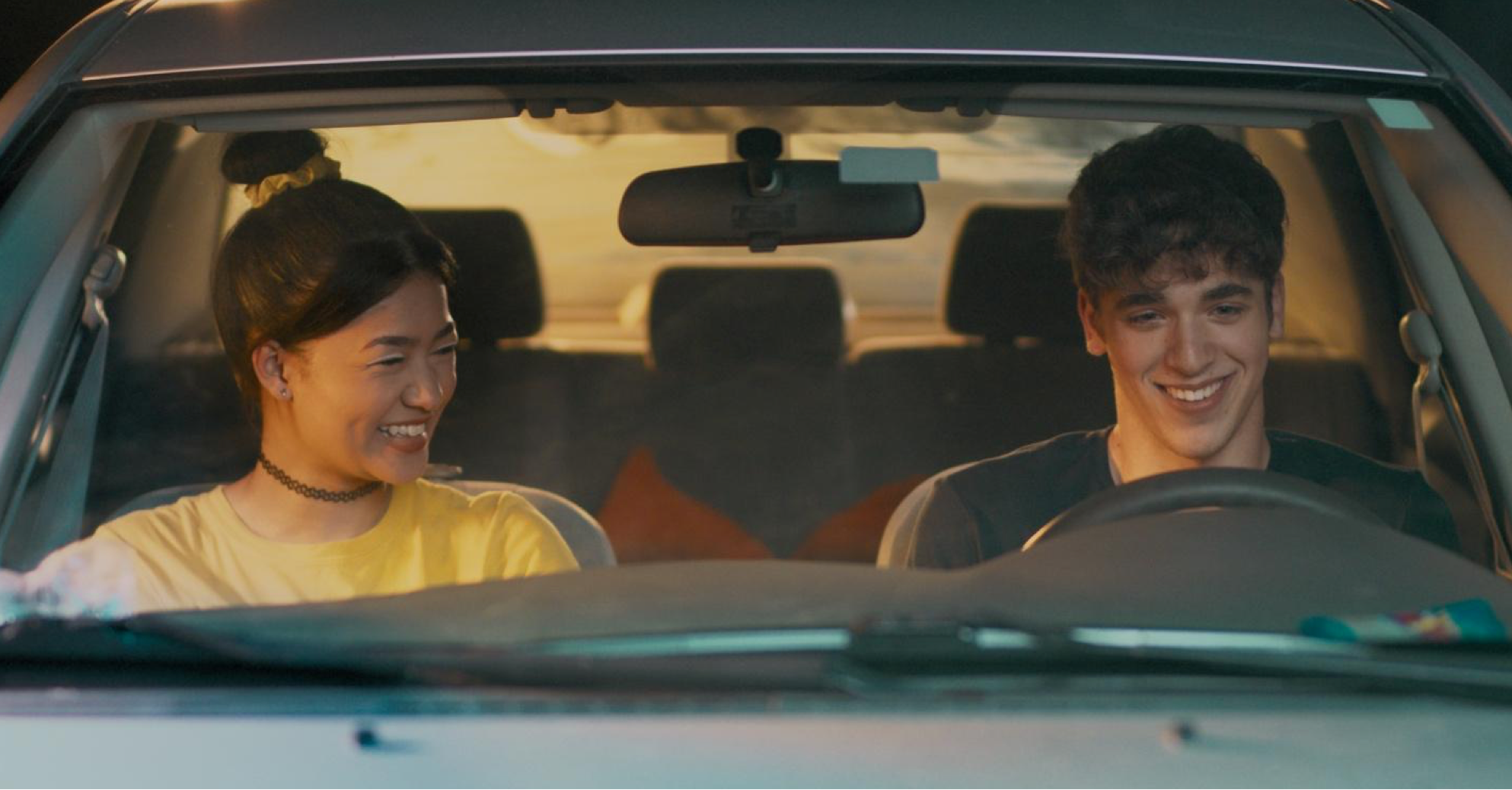
EGGHEAD AND TWINKIE - BFI Flare Film Festival review

At the start of the summer before he heads off to college, lovestruck Egghead (Louis Tomeo) decides to tell his best friend Twinkie (Sabrina Jie-A-Fa) how he really feels about her. The only problem is the relationship is definitively platonic from her point of view, and she's not told Egghead that she's gay and in love with a DJ she met online. When animator Twinkie sees an opportunity to visit her wannabe lover in Texas under the ruse of visiting an animation studio, she steals her dad's car and ropes the unwitting Egghead into making the long journey with her.

Based on her 2019 short film of the same name and re-uniting all of the same key cast members, Sarah Kambe Holland's debut feature delivers a fun spin on some tried and tested teen movie staples. Sharing a basic plot outline with Rob Reiner's under-appreciated 1985 John Cusack-starring road trip comedy, The Sure Thing (an at odds pair head out on the road with one of them given the promise of romance and/or sex at the final destination; they encounter vehicular trouble and comedy ensues), Egghead and Twinkie find their friendship put to the test when things inevitably start to go awry for them on their journey, although at least here there's little chance of romance suddenly blossoming between them. Spoiler alert, there's no last minute changes of sexual preference from Twinkie.

Where the film does veer off course from the expected norm is in the consideration of Twinkie's status as a young Asian-American woman with no links to her heritage. Adopted by her ultra-conservative white parents with an unspoken pre-requisite to conform in every way she can, Vivian aka Twinkie (her nickname itself a co-opted racial insult implying she's "yellow on the outside, white on the inside") needs to explore her Asian identity as well as her sexuality, and neither her parents or her supportive best friend Egghead can offer help with either. She's not just running towards her potential future as an out and proud lesbian, but also away from the confines her home life have put on her. Enter sweet Japanese waitress Jess (Asahi Hirano) who finds herself thrown into the middle of Twinkie's quest, and is more than willing to help guide her to a place where she's more comfortable with herself.

Mixing animation with live action, Egghead and Twinkie offers some cute Scott Pilgrim-esque cutaways to brighten up what is already a very cheerful, teen-friendly rainbow-coloured palette. Its unavoidable sweetness means the story is barely stretched in dramatic terms, with Twinkie's potential paramour B.D. (social media star Ayden Lee) offering the only glimmer of a more complex view of modern relationships, rendering the film relatively chaste and more focussed on finding something deep and meaningful... love. Told partly through flashbacks (including Egghead's disastrous movie theatre declaration of his true feelings for Twinkie), it may be blindingly obvious as the story progresses where we're going to end up, but the cast are all extremely likeable, the dynamics between them (in particular Jie-A-Fa and Hirano) work very well, and the film's more farcical elements are delivered with good comedic effect.

A modern, queer addition to the teen comedy genre, Egghead and Twinkie might not win awards for originality, but it's colourful, vibrant and super sweet, with solid chemistry between the leads.

Verdict

3.5/5

Egghead and Twinkie screened as part of this year's BFI Flare Film Festival. More information about the festival and its line-up can be found here.

Sunday, 21 March 2021

MY FIRST SUMMER - BFI Flare Film Festival 2021 review

Raised in isolation away from the world, when 16 year old Claudia's mother unexpectedly passes away, she must rely on the help of local teen Grace to remain a secret. Hiding from the authorities at her idyllic, remote house, the innocent Claudia (Markella Kavenagh) and savvy Grace (Maiah Stewardson) form a close bond as they enjoy a summer filled with sunshine and feelings of first love.

Written and directed by Katie Found, My First Summer is an unashamedly bright and delightfully whimsical Aussie teen romance between two girls who find safety and calm in the presence of the other. With Claudia shielded from the horrors and delights the outside world has to offer, it falls to Grace to school her on her own experience of life as a teenage girl, longing to escape from her family home. Together at Claudia's house, they can indulge all of their dreams of a never-ending summer as they tentatively explore their feelings for each other.

With some gorgeous cinematography by Matthew Chuang, it's a delightful world to inhabit for the film's 80 minute runtime - all Australian sunsets and magic hour sunlight breaking through the trees. There's an element of fantasy in the set up (this dream house in the middle of nowhere is almost too perfect), like a long-loved memory of youth, but the film avoids the pitfall of overplaying the connection between Claudia and Grace, which feels genuine and heartfelt, even when the film goes heavy on cutesy iconography like charm bracelets, candy necklaces and lollipop rings. Kavenagh impresses as the (gradually less) insular Claudia, but it's Stewardson who steals the show in a role that could have appeared smart-alecky in the wrong hands, outfoxing the local police in order to protect Claudia. The interplay between the two leads seems natural and honest, and they share a number of tender, sweetly romantic scenes that make you wish nothing will arrive to disturb their world together.

Like a bedsheet drying on a clothes line in a summer breeze, My First Summer sweeps you up and carries you away to their world of youthful innocence, exploration, and naivety about how long their time together can actually last. It's the stuff of teen romance dreams, like a warm, sunny picnic filled with pure summertime love. Utterly captivating.

Verdict
4/5

My First Summer is screening as part of the BFI Flare LGBTIQ+ Film Festival. The full line-up can be found on the BFI Player here.

Tuesday, 7 April 2020

BFI FLARE 2020 - THE LAWYER (ADVOKATAS) review

The BFI Flare festival wrapped up last weekend, having moved itself online in the outbreak of Covid-19 and the temporary closure of the host venue of BFI Southbank. This did mean that a lot of the features that were due to have their premieres at the festival (among them Romas Zabarauskas's The Lawyer) are still awaiting their red carpet debuts, but luckily I was able to get a sneak peek at it.

Corporate Lawyer Marius (Eimutis Kvosciauskas) is caught in an existential spin after the death of his father. With a thriving, successful career but a romantic life that consists of paying for an interaction with men online, he's hoping he can find more than a surface level connection with someone. When he meets Ali (Dogac Yildiz) on a pay for pleasure website, the emotionally distant Marius decides to take a leap, travelling to Belgrade in order to meet him, but his plans go awry when Ali opens up about his real life problems. A Syrian national living in a refugee camp, Marius has to decide whether he should put everything he has on the line to help Ali find a way to leave the country.

At the heart of Romas Zabarauskas's latest is a weighty subject matter far beyond what you might expect from our introduction to Marius and his yuppie dinner parties. Things first begin to change for Marius when he discovers that a guest at one of these parties is trans, a fact that has him questioning his complacency towards engaging in the lives of his friends and co-workers. He's been living his life in a manner that brings to mind Michael Fassbender in Shame; full of temporary lovers to appease his sexual appetite that seems to fulfil him at the time, but with no real interpersonal connections. As Marius searches for something deeper he begins to interact with Ali, who will dance and strip for him in exchange for money. As the two hit it off online, Marius travels to meet with Ali in what he expects will be an encounter based on sex, but that Ali hopes will lead to legal advice.

A story told across different countries and different languages (mainly English and Lithuanian), The Lawyer is a real world commentary on the refugee crisis that is affecting many areas of the world, with an emphasis on the dangers homosexual refugees may face when housed in the camps. This is a crucial plot point but is surprisingly not leaned into too heavily, keeping its dramatic moments quite low key. I wouldn't recommend going into this film expecting it to be a tense legal thriller, as it isn't. Despite the film's title of The Lawyer, this is more about the man who bears that job description, and the complex moral dilemma he finds himself in when his meeting with Ali causes him to question his boundaries. Whilst in Belgrade Marius is called upon by Darya, a client and friend to assist with her divorce, something that is not his speciality as a corporate lawyer, but still, a request he is quick to shoot down as a conflict of interest. Could he help her? Sure, but he's not willing to potentially sacrifice a part of himself for her. With Ali, this poses a different quandary for him, and the potential for love, sex and maybe more has him pursuing all options when the human rights specialists give him the cold hard facts.

In what is never a showy role, Eimutis Kvosciauskas is able to flesh Marius out from the icy cold man he begins the film as to something far more rounded, although it does take some time to get there. The focus remains on him, but his best scenes are when he is with Dogac Yildiz's Ali. Together they do share an unconventional, modern love story; kept apart by rules and restrictions that don't always make sense, and that leave them with no option but to stretch their own principles and Marius's view of the law. It's also open to interpretation as to how much Ali is manipulating Marius for his own benefit. There becomes a point when this isn't the case at all, but it's up to the audience to decide where.

The romance is certainly not one you can get swept up in and there is a feeling of restraint and distance between the pair throughout the film. It's not really a legal drama either, leaving most of the potential conflict that would arise from the scenario unexplored, although it's refreshing that director and writer Romas Zabarauskas didn't feel the need to force violence into the script. The Lawyer does leave a lot to ponder on the issues it raises about a refugee crisis, in particular to LGBTQIA refugees stuck in camps, and it's in its favour as a drama that will stick with you that the moral and ethical implications of a legal professional following certain paths are not all resolved when the credits begin to roll.

Saturday, 28 March 2020

BFI FLARE 2020 - DISCLOSURE review

Using interviews with a number of key trans voices working in today's entertainment industry, Sam Feder's Disclosure looks at the history of transgender representation on the big and small screens and asks how society's negative conceptions of trans men & women have been informed by what they've seen.

Going all the way back to the birth of cinema up to the present day, the contributors speak from their own personal experiences about what it felt like to them to see transgender characters on screen, although more often than not in a negative light. It could be quite easy to look back on these shows through a 2020 lens and pass judgement on their failings, but the contributors here are remarkably fair and balanced in their appraisals of representations. It's quite damning on the lack of representation that they can look back on the countless depictions of trans characters in hospital dramas like E/R and Grey's Anatomy being slowly killed by elements of their transition, or police procedurals like NYPD Blue where trans people are often portrayed as sex workers and think, at least it's something. The same goes for talk shows like Jerry Springer and Maury, out for shock value with dramatic revelations of birth genders, but that also allowed trans people to see something approximating their own feelings and frustrations reflected back on them from the TV screen.

What comes across in these interviews (with actresses like Laverne Cox, Candis Cayne and Trace Lysette, and actors like Michael D. Cohen and Marquis Vilson) is how eager the trans community are to having an open and honest conversation, but also how exasperating it is to see themselves continuously portrayed in a negative light, just for existing. There's a large section of the film that might has well have been subtitled "the problem with The Crying Game". A film that can be applauded for igniting a debate in the early 90s, it ultimately is defined by the negative convulsive reaction the straight white cis man lead character has to discovering the 'twist' (leading to Stephen Rea vomiting in the bathroom), and the way the shock factor of that film's plot device was then re-used for comic purposes in films like Naked Gun 33 1/3rd and Ace Ventura: Pet Detective.

There's a key moment halfway through the doc where, having discussed and seen clips from countless problematic films and TV programmes like Dressed to Kill and Silence of the Lambs (actress Jen Richards recoils when telling the story of coming out trans to a friend, and their only point of reference was Jame Gumb), when talking about a scene of rape involving Famke Janssen's trans character Ava Moore on Ryan Murphy's supposedly progressive show Nip/Tuck, Laverne Cox has to break from being another worn down talking head in complete despair to ask "did they stop to consider a trans person watching?". Of course the answer is almost undoubtedly no, as for even in films and TV aimed towards a queer audience, the trans community has been othered and depicted as something to gawk at, often in Hollywood films where cisgender actors like Eddie Redmayne and Jared Leto can portray trans characters with award winning results due to their on screen transformation; something that has always reverted back by the awards ceremony.

It's impressive that in a conversation that's continually evolving, this film feels incredibly up to date. The inclusion of shows and characters that are from only a few years ago (Laverne Cox in Orange is the New Black a prime example) does allow us as the audience to reassess our opinion of what's acceptable, and also of what we want to see on our screens. There's footage of interviews from not so long ago with hugely influential people such as Oprah Winfrey and Katie Couric saying outrageously inconsiderate things that you would hope would not be accepted today, and it's clear that the visibility and voices of outspoken people like Candis Cayne, Trace Lysette and Chaz Bono are having a positive effect.

If I'm picking faults, it is weighted more towards the stories of trans women than trans men with only a cursory mention of non-binary people, although this is also something that's acknowledged in the film to be a problem within entertainment as a whole, and perhaps is simply too big a discussion to fit into one film. As a document of where we are now, Disclosure is a fascinating, well-rounded statement that a change in perspective is a positive thing. We are at a tipping point in the trans "debate" socially and culturally, and this film's purpose is not to shit upon poor depictions and name and shame those who do so, but to ask its audience to consider why trans lives are being portrayed this way and what could be done better.

It's encouraging to see how far we've come in a short space of time in increasing trans visibility on screen and that, as evidenced in this documentary, there's strong voices out there to encourage the continued progress. Disclosure is a fantastic piece of documentary filmmaking that will hopefully reach a wide enough audience to add more voices to that fight.

Disclosure is now screening on BFI Player as part of its BFI Flare at Home season, and more information can be found at disclosurethemovie.com.

Thursday, 26 March 2020

BFI FLARE 2020 - DON'T LOOK DOWN review

In a stylish apartment overlooking the streets of Paris, a group of five strangers meet to discuss the one thing they have in common; the man who is locked the room next to them. A parasitic and controlling presence in their lives, in some way or another they have all been mistreated and manipulated by him. As they collectively try to work out why he was able to effect their lives so much, they go into the room one by one to confront their problems, and him.

With topics of discussion ranging from politics to secret desires, the five young, attractive, but narcissistic and damaged people (Manika Auxire, Geoffrey Couet, Simon Frenay, Francois Nambot & Lawrence Valin) cook, eat and flirt with each other, building a steady stream of tension, and not just sexual. Directed and written by Olivier Ducastel and Jacques Martineau (of Theo and Hugo fame), due to the confined nature of the single setting it wouldn't surprise if this project originally started out as a play, although that doesn't seem to be the case here. It certainly draws from similar single location narratives, like Alfred Hitchcock's Rope and Sidney Lumet's 12 Angry Men, although in this case they know the accused is guilty of the social and emotional crimes against them. The why is the real mystery here. Rope is an interesting film to compare this to, as similarly, the person the party is based around is never seen on screen, but is never not a topic of discussion. And boy, there's a lot of discussion.

All five of them have different reasons to feel aggrieved by their common enemy, and this film is in no real rush to tell us why. It's a purposely talky piece, finding its human drama in the commonality they find between the hitherto complete strangers they are in a room with; but it's also an incredibly self indulgent film that's not averse to a sing-a-long interlude and a stress relieving dancing scene (complete with flossing). There's a lot that adds genuinely interesting flavour to the plot, such as the debate as to how to cut an apple tart into five equal pieces when it would be much easier to cut it into six; something Lawrence considers bad luck considering the scenario they're collectively faced with. But sadly, the exploration of the decisions and conclusions they are making over the course of the night does hit fallow ground occasionally, making the (not extensive) runtime of 89 minutes seem overly long and, once again, self indulgent. It's a visually striking film, with the apartment bathed in neon hues, but at the end of the day there's only so much you can do to make a kitchen/diner look exciting.

It's certainly not without merit, offering frank and revealing discussions of sexuality (something that could only be presented as subtext in Hitchcock's Rope), and the cast are all uniformly solid in their varying roles, given a chance to bounce off each other in a variety of pairings in the oddest group therapy session you'll ever see. Unfortunately the stagey set up turns out to be a drawback the story can't overcome.

Wednesday, 25 March 2020

BFI FLARE 2020 - FOR THEY KNOW NOT WHAT THEY DO review

Dodging the coronavirus by finding a new venue online as #BFIFlareAtHome, this year's festival continues on the BFI Player with For They Know Not What They Do, Daniel Karslake's documentary about the intersection and difficulties families have faced in finding the balance between their religion and their children's sexual and gender identities.

In frank interviews with Karslake, evangelical Christians like the Robertson's tell of their reaction to finding out their 12 year old son Ryan was gay. Telling him that he was putting his soul in jeopardy, to appease his parents Ryan went into years of conversion therapy in an effort to fight his feelings, before spiralling into a drug habit and homelessness. Ryan's parents, Rob and Linda, are upfront about their initial reaction and their failure to support their son by believing in the vitriolic hatred of homosexuality that was preached at their church and spread through their community.

A follow up to Karslake's previous film For The Bible Tells Me So (that also covered similar themes and also featured Bishop Gene Robinson of the Center for American Progress), the title here, For They Know Not What They Do, evokes a need for forgiveness and understanding of why these religious are so against these marginal groups, and it's clear from the documentary that what most of the objecting parents and grandparents suffer from is a lack of education on the matter, or perhaps it could better be described as mis-education. The film continuously cuts to disturbing video footage of pastors and preachers encouraging violence against homosexuals and transgender individuals, leading into Vico's story. Raised as Catholic and fearful of his father and grandmother's reaction to his homosexuality but met with acceptance and love, his world changed when he encouraged his friends to go with him to the Pulse nightclub in Florida on the night of the mass shooting in 2016.

The other two key subjects offer a glimmer of hope for the acceptance of transgender people, with the inspiring story of Sarah McBride who, after coming out as transgender in her last year of college, has continued to pursue the career in politics she wanted, including an internship in Obama's White House and speaking at the Democratic National Convention as the first openly transgender person to do so. Her story is not without its hardships, but there's something so moving about how her father smiles as he talks about her achievements. It also goes to highlight how much has changed since 2016. The last main focus of the film is on Elliot, a mixed-race teenager about to go to college. Despite knowing early on that he was transgender, Elliot fought back against his identity and tried to present as female, leading to a personal crisis and self harm, something that is all to common among transgender people. His parents are also quite open about their initial confusion about what to do; but its fair to say that the aim of the film is not to chastise those who were scared about their children's identities, but to tell their stories in order to help others react in a better way.

Karslake's documentary tells four wildly different stories of people and families from all different backgrounds. It doesn't hold back from showing how the current White House administration has done immeasurable harm to LGBTIQ communities, with a sharp rise in the murders of transgender people of colour in 2017, the barring of transgendered people from joining the armed forces and the continued acceptance of conversion therapy in 41 states where they are still legal. For They Know Not What They Do succeeds in giving each story the platform it deserves, featuring some traumatic stories but is ultimately an inspiring and uplifting experience. It should be seen be the friends and family of anyone in the LGBTIQ community, and hopefully by more too. Easily one of the best films of the festival.

For They Know Not What They Do is currently available on the BFI Player until March 29th as part of their #BFIFlareAtHome content, along with other features and a whole host of short films too. Catch them while you can.

BFI FLARE 2020 - KEYBOARD FANTASIES: THE BEVERLY GLENN-COPELAND STORY review

Best known for the 1986 album Keyboard Fantasies, Posy Dixon's documentary charts Glenn-Copeland's re-emergence as an artist after his definitive album was re-discovered by collectors in the last decade, leading to a new tour to a new generation of fans.


After going to Montreal to study music in the early 1960s, Glenn-Copeland soon found that being the only openly non hetero-normative person on campus was too big a barrier, and so after a run in with his parents and a close call with electro shock therapy, he fled the school to pursue a career as a musician, ending up in rural Canada. Releasing folk and jazz infused albums that were difficult to market, after a period of failures in releasing new material this lead to him self releasing an initial run of 200 cassette tapes of Keyboard Fantasies (recorded with the help of an Atari home computer) in the mid 1980s to little cultural appreciation. Flash forward 30 years and thanks to the collective power of music aficionados, Keyboard Fantasies is in demand across the globe and finally getting the respect it deserves.

I'll be honest that I wasn't familiar with Glenn-Copeland before this documentary, but it's a great introduction to his work in a similar vein to Searching For Sugarman, albeit with the artist upfront and centre in talking heads and live performances. The film is a compact 59 minutes long, but there's some fantastic performances peppered throughout from a recent tour, accompanied by the band Indigo Rising. The highlight of the documentary is seeing how these two generations of musicians, one in his mid 70s and the others in their early 20s, learn from each other and how they so easily blend together during the live shows. It's also incredibly moving to see how much fun Glenn-Copeland is having, playing for a much larger and also younger audience, engaged in the story he has to tell.

What's refreshing is that Glenn-Copeland's gender identity is treated as largely inconsequential for the majority of the film, only becoming a topic of discussion in the last 20 minutes, perhaps as his gender realisation happened after the release of Keyboard Fantasies and before its cultural re-appreciation occurred. It's interesting that director Posy Dixon didn't try to give this aspect of Glenn-Copeland's life a closer inspection for dramatic reasons, but from his own admission, despite growing up black and queer and then having the realisation that he was male later in life, due to his family life and quite possibly due to living in Canada (which from the tour footage seems like a joyous place to live), he didn't receive the same level of abuse that others did.

Capturing Glenn-Copeland's feelings that he has found his purpose, this is a touching documentary that offers a captivating story with a beautiful musical backdrop. Keyboard Fantasies: The Beverly Glenn-Copeland Story is now playing on the BFI Player as part of the #BFIFlareAtHome season.

Tuesday, 24 March 2020

BFI FLARE 2020 - Five Films For Freedom

Despite the best efforts of the Coronavirus to cancel every major film festival over the next couple of months, the BFI Flare LGBTIQ+ Film Festival team have adapted as best they could in these difficult times, moving some of the features and tons of the shorts over to the BFI Player so that people can enjoy them in the comfort of their own homes as #BFIFlareAtHome.

Among the short films is a collection they've dubbed Five Films For Freedom; a collection of dramas and documentaries from LGBTIQ+ filmmakers, telling stories that could only be told by them. Here's a brief overview of what they have to offer.

When Pride Came to Town follows Bjorn-Tore who left his rural hometown of Volda after coming out to move to Oslo to find acceptance. Decades later he's now returning to Volda to attend their Pride parade, the first of its kind for a rural Norwegian town. The film sees Bjorn-Tore find a town much different to the one he left, with his neighbours proudly hanging a rainbow flag outside, although the documentarians do explore the opinions of those locals whose attitudes haven't caught up yet, including one woman who states that "my best friend is gay and I'm okay with that. He's living in sin, of course", and the words of Hans Reite, a pastor who is against Pride parades happening anywhere. The reconciling of sexuality and religion is a common one in films at Flare, and When Pride Came to Town is just the tip of the iceberg for this year. Well structured and presented, this is an uplifting and moving doc that can see the visual power of the rainbow flag and uses it to its advantage.

134 is a short Irish drama that shows a young transgender girl as she competes in an Irish dancing tournament. Largely told from the point of view of the parents as her mother plays scenes from the past in her head from when she was unsupportive of her child's gender identity (something her father is still struggling to do), it only hints at the intolerance her daughter is facing in pursuing their dream, but there's an interesting idea in the exploration of Irish dancing (and competitive dancing as a whole) as an acutely gendered activity that needs to move away from its traditional definitions.

Flare is an international festival that screens films from across the globe, including the Brazilian short After That Party. Leo seeks the help of his friend Carol in working out how best to speak to his supposedly straight father after witnessing him kissing another man at a party. It's a premise that could have been mined for gritty drama, but instead After That Party is pleasantly light, fluffy and comedic in its presentation. It's a sweet natured film that's not interested in digging for drama in Leo's discovery, and is more interested in showing a story of acceptance, albeit with some comedy from the social awkwardness of it all.

The final documentary in this collection is a very short snapshot of Pxssy Palace, a monthly club night in Hackney that champions queer people of colour. In the doc there's a lot of voiceover explaining how they started with house parties before finding a fixed venue (a studio space in Hackney), with footage of them in fashion shoots and as photographers creating "an archive of queer nightlife". What's most surprising is the lack of footage from an actual club night to convey the real atmosphere. Instead the documentarians have given their subjects better lighting and a glittery back drop for them to dance in front of in slow motion, all the better to control their image. How very Hackney. It's a stylish and slick looking film, but plenty of room has been left to expand on the subject.

The final short in the collection is probably my favourite, and a rare genre short for this festival. Something in the Closet isn't shy about its subtext, when after a game of spin the bottle two teenage girls kiss in a closet for the first time. Struggling to know how to respond to the realisation of her sexuality, Madi avoids talking to her mother and faces the bullying of her friends, all while a malevolent force with glowing red eyes appears in her bedroom closet. A mini horror filled with teenage angst, forbidden love and a compelling story; it's a visual metaphor writ large, but done very well.

The Five Films For Freedom are available now on the BFI Player without a subscription, with plenty more shorts and features available to those who sign up. It's well worth taking advantage of a free trial membership just to catch some of the BFI Flare 2020 features that are being added during the festival.

Saturday, 31 August 2019

SEAHORSE review

When Freddy McConnell decided he wanted to have a child, as a transgender man he decided the simplest option would be to carry the child himself, coming off his prescribed testosterone and onto folic acid to prepare himself for potential pregnancy. Director Jeanie Finlay follows Freddy as he confronts issues with his biology, self belief and societal expectations of what he's allowed to do.


The basic logline for Seahorse (and its subtitle "The Dad Who Gave Birth") would undoubtedly have the heads of some Daily M@!l readers spinning, but as sensational a headline it may make, that is not the aim of director Jeanie Finlay or the film's subject, Freddy McConnell, who has gamely allowed intimate access into the process of being a trans person wanting to conceive a child, hoping to provoke nothing other than discussion and offer hope to others.

Finlay's films have always been notable for the willing contributions of her subjects (The Great Hip Hop Hoax, Sound it Out and the excellent Game of Thrones documentary, The Last Watch that managed to silence some of those disappointed in the finale but showing the sheer amount of work and love that went into making the show), and it's no different here. With complete access to his life and interactions with Freddy's family & friends, and it's an important part of the film that his family don't all come across as the open, liberal people you would hope or expect them to be. Much like the audience for this film, they are real, inquisitive people who often clumsily try to navigate their way through this experience by asking Freddy awkward questions. The film isn't trying to vilify them, but as a document that may be of help to viewers who may encounter such a scenario in the future, show what questions don't need to be asked. This is evident at a dinner populated by Freddy's mother's friends aimed at imparting wisdom of "motherhood" onto Freddy, when one woman has to ask "so are you going to be called Dad?", before the group starts to list heteronormative ideals of masculinity and conjure up images of Demis Roussos as something for Freddy to aspire to.

Although this story has plenty in common with any story of someone hoping to start a family and conceive (expensive trips to the doctors, the near misses, the pregnancy tests), it's crucial that the specific journey of Freddy as a transgender person is captured, something that a talented filmmaker like Jeanie Finlay understands could not accurately be told be a cisgender person. Luckily, Freddy is an articulate video diarist, recording late night thoughts and important steps in the journey, like when his prospective co-parent CJ who had been an important part of the early stages, has second thoughts about the arrangement for unclear reasons and walks away. It's here that Freddy's mother steps in to become a big part of the film, sharing her own stories of being a single parent, including the absolute killer line "I loved being pregnant. Everyone should experience it, especially men". She's also able to share photos and videos of Freddy's childhood, a potentially tricky resource for Finlay to mine, but treated respectfully and with Freddy's consent.

The film does a great job of documenting the unconscious bias Freddy faces at every step, something that won't survive Freddy's strong attitude, changing the M to a P on every page of the Maternity paperwork he is asked to fill out. This is done not as an act of defiance but in order to point out how unprepared the established systems are to deal with trans rights in something as basic as starting a family, a luxury cisgender people have no barriers in doing. One of the threads that runs through the film is Freddy's relationship with his own father, a figure absent from the film and notably from Freddy's everyday life. Their exchanges occur via polite but strongly worded emails, his voice only heard in the home video footage of Freddy as a child.

Seahorse is a thoughtful film that tells a deeply human story of one person wanting to bring more life and love into the world, and why them being trans should not prevent them the opportunity to do that. Culminating in a beautiful scene that is profoundly moving and joyful, Seahorse questions what it takes to be a parent and offers a tremendous amount of hope and optimism for the future.

Verdict
4/5

Saturday, 17 August 2019

JT LEROY review

Now in cinemas and available to download, starring Kristen Stewart and Laura Dern and based on one of the greatest literary hoaxes of all time, Justin Kelly's film tells the true story of how two women came to embody the fictional street kid turned author, JT Leroy.


You may not be aware of the "hoax" in the early 2000s that shook the literary and celebrity world, but this film tells of how writer Laura Albert, writer and creator of fictional personalities that she would often use to confront her own issues, convinced her sister-in-law Savannah Knoop to pose in photographs as JT Leroy, the credited author of Albert's latest book, Sarah. When Hollywood comes calling to adapt the book into a film and JT becomes an in demand presence at meetings, parties and the Cannes Film Festival, Knoop becomes a semi-reluctant avatar for JT until, with questions about her own identity coming forth and a growing rivalry with Albert over the ownership of JT, the entire scheme starts to unravel before them.

Quite fittingly this story has been told from two different angles before, first in Savannah Knoop's book Girl Boy Girl: How I Became JT Leroy, then two rival documentaries - The Cult of JT Leroy and Author: The JT Leroy Story. The latter, directed by The Devil and Daniel Johnston filmmaker Jeff Feuerzeig, was one of my favourite films of the year it was released, although it was very clearly told from the point of view of Laura Albert. She is essentially the narrator of that film, asserting her ownership of the persona she created, and not always coming over well. This film takes inspiration from Knoop's memoir (the film was also co-written by Knoop with director Justin Kelly) and is very purposely told from the other point of view, from the person who became the physical manifestation of JT at the photo shoots and celebrity parties.

What is most striking about the film is how relevant its subject matter feels to today, even more so than the documentary which only came out a couple of years ago. Through Knoop's eyes this is a study of gender and sexuality that is years ahead of its early 2000s setting, but never feels like it is appropriating the current exploration of gender identity. Simply, the story of JT was the start of a sea change in how these concerns are explored. In the film we see Knoop, a short haired, sexually fluid young woman binding her breasts to look less feminine (or at least an atypical kind of feminine), adopting a male persona by donning baggy clothes, a long blonde wig & sunglasses and pitching her voice down a couple of octaves. Physically JT appears of ambiguous gender, something that increasingly confronts Knoop's own personal feelings as they consider sexual desire towards Diane Kruger's Eva. Is Eva attracted to Knoop's physical appearance in the form of a man, or is it the ambiguity that holds the attraction? Added to that is Albert's relationship with Eva, talking to her on the phone under the guise of JT. Collectively JT and Eva are in a relationship between two people that actually involves four people, one of whom is fictional.

A large part of the success of the film is the dream casting of Laura Dern as Albert and Kristen Stewart as Knoop. Not only are they great physical matches for their counterparts, they share fantastic on screen chemistry as the collective writer, body and conscience of JT Leroy. Stewart has consistently proven that she is one of the best young actresses working today, and the uncomfortable reservedness she has previously been criticised for works for the bewildering puzzle her character is pulled into. As Laura Albert, Dern is simply astonishing, capturing the nuances of Albert's mannerisms (very much on display in Author) down to a T. She is a larger than life character, desperate to achieve a higher level of respect and celebrity, and Dern captures that hunger well as Albert's jealousy allows the facade to slip as she slips from character to character. Although Albert's discomfort at losing part of JT to Knoop is well explored in this version of the story, what is less covered is her reasons for creating these multiple fictional personas, as told in Author. A victim of abuse who would call suicide hotlines pretending to be teenage runaways, she created a method of escape that she continued to use when working for phone sex chat lines and when crafting the persona of JT.

It is helpful to have some prior knowledge of the story in order to truly understand some of the eccentricities that seem outlandish. I would recommend seeing Author... if only to see that Dern's horrendous "British" accent as alter ego Speedy is actually pretty damn close to Albert's original, and also to understand the true identity of Diane Kruger's ambiguously European Asia Argento facsimile, Eva Avalon. I would assume the new character has been created to avoid any potential legal issues coming from Argento, but without that prior insight into Argento's personality there's something a bit lacking in Kruger's interpretation and relationships with both Albert and Knoop, leaving her character the least developed. Jim Sturgess also appears as Savannah's brother and Laura's husband Geoff, a wannabe successful musician pulled into this bizarre world of celebrity and given his own fictional counterpart in the form of Astor, member of Twist and Scream, the band "JT" writes the lyrics for, fronted by Albert's Speedy. Sturgess is perfectly fine in this supporting role, well aware that this is Dern's and Stewart's film.

If this film is your first exposure to the story of JT Leroy you may be forgiven for thinking some of the details may seem far too outlandish to be true, but in all honesty this is about as bizarre a feature film interpretation of the real story could be, and there's various books and documentaries to back up and expand on the story. Dean and Stewart deserve high praise for accurately embodying Albert and Knoop who are painted in the film as far more complex characters than JT ever was. As a real life account of gender identity and sexual fluidity JT Leroy is an important and timely film, the subject matter given no easy answers yet asking a lot of the right questions.

Verdict
4/5


(this review is an update of the original review, published after the premiere of the film as the closing night gala at this year's BFI FLARE Film Festival.)

Monday, 8 April 2019

GIANT LITTLE ONES: BFI FLARE FILM FESTIVAL review

Following a late night sexual encounter with his best friend Ballas (Darren Mann), Franky (Josh Wiggins) gets ostracised by his high school swimming team, dumped by his girlfriend Cil (Hailey Kittle) and becomes the target of bullies. Hoping to handle the situation and rebuild his friendship with the resistant Ballas without the interference of others, he shuns the offer of guidance from his single mother (Maria Bello) and his homosexual father (Kyle Maclachlan) that he cut out of his life after their divorce.


Queer coming of age stories have become increasingly present on our cinema screens, with The Miseducation of Cameron Post, Love, Simon and Call Me By Your Name a few examples of films that managed to reach a wide audience. Giant Little Ones appears to tick many of the same boxes as Love, Simon - the all American male lead, complex parental relationship, the high school setting and the trauma of being outed against their will. What sets Giant Little Ones apart is a story that is more complex than it first seems, its main character's journey less predictable than it appears.

It's a beautiful looking modern suburbia, with complicated and disassembled family units occupying wide streets with bicycling kids and late night fireworks. To an outsider of that world it's both realistic and somewhat magical, the early scenes show an idyllic American teenage life before a loss of innocence changes everything. Giant Little Ones also convincingly encapsulates some aspects of the spectrum of high school sexuality and the grown-ups' struggle to keep up. There's a thrill to Cil's early encounters with Franky and her desire to lose her virginity to him in the right way (his offer of sneaking off to the park after dark is quickly dismissed), and some overreactions from the teachers who see the bullying of one of Franky's gay classmates and decide to segregate the locker room. In this world of sexual relationships and identity that is opening up to them, it's not easy to announce yourself in any way or stray from the pack.

Although this film is Franky's experience he isn't the most interesting character in his own story, he's just found himself in an extraordinary situation. That sounds like a slight against the film, but there's an array of interesting secondary characters (notably most of whom are female) that offer council to Franky whilst dealing with their own issues. Mouse (Niamh Wilson), a girl exploring her gender identity by stuffing her shorts with a mock penis is comfortable in exploring who she is and is seemingly judgement free from the majority of the school, apart from Franky pointing out that her substitute penis is almost comically large. Another stand out is Taylor Hickson's Natasha, the sister of Ballas and old friend of Franky's. A survivor of assault with a tendency to drink too much, she is treated by her parents and former friends as damaged, unable to rebuild her life and find her way back to normality. Both of these young women have stories as complex, if not more so, as Franky.

The biggest problem the film has is how Franky's relationship with Ballas, very much the core of the story in the early scenes, falls by the wayside for a large portion of the story. Obviously there is a chasm that has opened up between them and their conflict is addressed in a typically masculine display of violence in the film's most troubling scene, but the film sets up a unique dilemma between these best friends which could have been better explored. Apart from that there's a lot to like about the film, not least the performances by its young cast, lead by Hilary Swank lookalike Josh Wiggins.

Whilst not immune to skipping around the odd cliche, what is most admirable about Giant Little Ones is how it subverts the coming out story and brings in supporting characters (Franky's female friends, his parents, including a great turn by Kyle Maclachlan) to paint a much larger, complicated picture about teenage sexuality and fighting back against the norm.

Verdict
3.5/5

Sunday, 7 April 2019

JT LEROY: BFI FLARE FILM FESTIVAL review

The closing night film for this year's BFI Flare LGBTQ+ Film Festival, starring Kristen Stewart and Laura Dern and based on one of the great literary hoaxes of all time, Justin Kelly's film tells the true story of how two women came to embody the fictional street kid turned author, JT Leroy.


You may not be aware of the "hoax" in the early 2000s that shook the literary and celebrity world, but it follows how writer Laura Albert, writer and creator of fictional personalities that she would often use to confront her own issues, convince her sister in law Savannah Knoop to pose in photographs as JT Leroy, the credited author of Albert's latest book. When Hollywood comes calling and JT becomes an in demand presence at meetings and parties, Knoop becomes a hesitant avatar for JT before eventually the entire scheme starts to unravel before them.

Quite fittingly this story has been told from two different angles before, first in Savannah Knoop's book Girl Boy Girl: How I Became JT Leroy, then two rival documentaries - The Cult of JT Leroy and Author: The JT Leroy Story. The latter, directed by The Devil and Daniel Johnston filmmaker Jeff Feuerzeig was one of my favourite films of the year it was released, although it was very clearly told from the point of view of Laura Albert, who talks to people on the phone as JT and whose words became those of JT's. She is essentially the narrator of that film, asserting her ownership of the persona she created. This film, taking inspiration from Knoop's memoir is very purposely told from the other point of view, from the person who became the physical manifestation of JT at the photo shoots and celebrity parties.

What is most striking about the film is how relevant its subject matter feels to today, even more so than the documentary which only came out a couple of years ago. Through Knoop's eyes this is a study of gender and sexuality that is years ahead of its early 2000s setting, but never feels like it is appropriating the current exploration of gender identity. Simply, the story of JT was the start of a sea change in how these concerns are explored. In the film we see Knoop, a short haired, sexually fluid young woman binding her breasts to look less feminine (or at least an atypical kind of feminine), adopting a male persona by donning a long blonde wig and sunglasses and pitching her voice down a couple of octaves. Physically JT appears of ambiguous gender, something that increasingly confronts Knoop's own personal feelings as they consider sexual desire towards Diane Kruger's Eva. Is Eva attracted to Knoop's physical appearance in the form of a man, or is it the ambiguity that holds the attraction? Added to that is Albert's relationship with Eva, talking to her on the phone under the guise of JT. Collectively JT and Eva are in a relationship between two people that actually involves four people, one of whom is fictional.

A large part of the success of the film is the dream casting of Laura Dern as Albert and Kristen Stewart as Knoop. Not only are they great physical matches for their counterparts, they share fantastic on screen chemistry as the collective writer, body and conscience of JT Leroy. Stewart has consistently proven that she is one of the best young actresses working today, and the uncomfortable reservedness she has previously been criticised for works for the bewildering puzzle her character is pulled into. As Laura Albert, Dern is simply astonishing, capturing the nuances of her mannerisms down to a T. She is a larger than life character, desperate to achieve a higher level of respect and celebrity, and Dern captures that hunger well as Albert's jealousy makes her slip from character to character. Although Albert's discomfort at losing part of JT to Knoop is well explored in this version of the story, what is less covered is her reasons for creating these multiple fictional personas. A victim of abuse who would call suicide hotlines pretending to be teenage runaways, she created a method of escape that she continued to use when working for phone sex chat lines and when crafting the persona of JT.

It is helpful to have some prior knowledge of the story in order to truly understand some of the eccentricities that seem outlandish. I would recommend seeing Author... if only to see that Dern's horrendous "British" accent as alter ego Speedy is actually pretty damn close to Albert's original, and also to understand the true identity of Diane Kruger's Asia Argento facsimile, Eva Avalon. I would assume the new character has been created to avoid any potential legal issues coming from Argento, but without that prior insight into Argento's personality there's something a bit lacking in Kruger's interpretation and relationships with both Albert and Knoop, leaving her character the least developed. Jim Sturgess also appears as Savannah's brother and Laura's husband Geoff, a wannabe successful musician pulled into this bizarre world of celebrity and given his own fictional counterpart in the form of Astor, member of the band "JT" writes the lyrics for, fronted by Albert's Speedy. Sturgess is perfectly fine in this supporting role, well aware that this is Dern's and Stewart's film.

If this film is your first exposure to the story of JT Leroy you may be forgiven for thinking some of the details may seem far too outlandish to be true, but in all honesty this is about as bizarre a feature film interpretation of the real story could be, and there's various books and documentaries to back up and expand on the story. Dean and Stewart deserve high praise for accurately embodying Albert and Knoop who are painted in the film as far more complex characters than JT ever was. As a real life account of gender identity and sexual fluidity JT Leroy is an important and timely film, the subject matter given no easy answers yet asking a lot of the right questions.

Verdict
4/5

Tuesday, 3 April 2018

BECKS - BFI FLARE FILM FESTIVAL review

Screened as part of the BFI FLARE LGBTQ+ Film Festival, Lena Hall stars as musical Becks, returning home after a break up to reacquaint herself with her past and her mother.


Returning to your childhood home may be an indie movie staple at this point (Garden State perhaps the most obvious example), but for Becks (Lena Hall) there's an added element. Away from the judgement and conflicted feelings of her mother, Becks has been allowed to live her life as she wishes without having to justify herself. Moving back home, both to recuperate after her separation from girlfriend Lucy (Hayley Kiyoko) and because she's broke, she's once again under the roof and the watchful eye of her mother (Christine Lahti).

Feeling creatively stifled, she takes her friend Dave (Dan Fogler) up on his offer to perform live music at his local bar Perfectos, where she meets bored housewife Elyse (Mena Suvari). Agreeing to help tutor her on guitar, soon the chemistry between Becks and Elyse leads to a complicated romance. As a veteran of the LA dating scene Becks is well aware that Elyse may just be a bored housewife, using her to fulfil a longstanding lesbian fantasy, but soon starts to feel a real connection with her, despite their wildly different lives. Whereas Becks has struggled to live as a touring musician, Elyse has a huge house, close friends and a seemingly ideal relationship with husband Mitch (Darren Ritchie). Basically, as straight and white as their picket fences.

I wasn't familiar with Lena Hall before this film, but she's quite a multi-talented presence. It's a compelling performance that makes you wish for Becks to come out on top, even when she's less than likeable. The film is peppered with musical performances from Hall, bringing to mind the emotional heft of other musical films like John Carney's Once. It's quite clear the filmmakers know that it's best to just put the camera on Hall and let her do her thing.

Of the supporting cast, Becks has an interesting friendship with Dan Fogler's Dave, a former teenage flame who sees Becks potential but is also aware of her ability to sabotage herself. It's not a huge role for Fogler, but he and Hall have great interplay in all of their scenes. Top of the supporting cast is Christine Lahti as Becks' mother. It would have been quite easy to play her as a one note, judgemental religious stereotype, but Lahti sees the layers in her character and the conflicts she has between her beliefs and her love for her daughter.

But at the core of the film is the relationship between Becks and Elyse. Mena Suvari, looking like an all American girl cliche doesn't at first appear to have too much depth to her, but she does keep you guessing as to what her long term intentions are. Is she conflicted about her sexuality? Is she using Becks as a way of escaping her unhappy marriage? In what direction does she want her life to go? There is real chemistry between Mena and Lena, although their liaisons do lead to what might be the films only real mis-step, in a sex scene that although admirably frank, tips over into the kind of 'comedy of embarrassment' scenario that would be more suited to the American Pie series.

Although Becks might be walking a well-trodden indie film path, it does it well enough to be a standout. There's a sweet, endearing romance at the centre of the film, but it's the performance of Hall, whether behind a microphone or not, that makes this one worth seeking out.

Verdict
4/5


Thursday, 16 October 2014

AUSTIN TO BOSTON - BFI LONDON FILM FESTIVAL review

Charting the journey of a group of bands on the Communion record label as they embark on a cross country tour, Austin to Boston was screened as part of the 2014 BFI London Film Festival's Sonic strand.